OpenAI Kills Its n8n Rival, Bets on "Dots" Instead
OpenAI is shutting down Agent Builder, the no-code tool built to rival n8n, in favor of always-on "Dots" agents. Here's what the shift actually changes for automation builders.
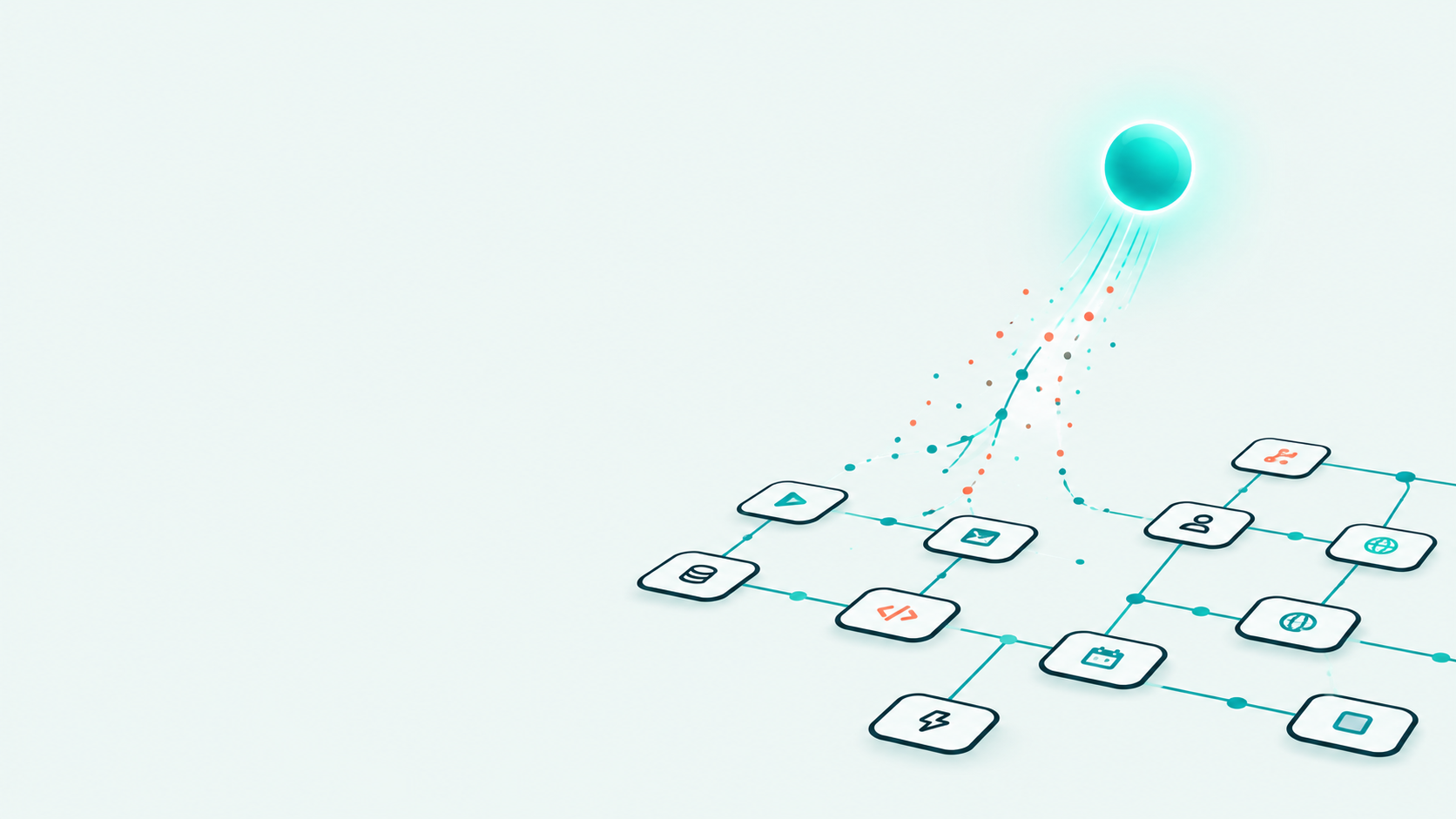
OpenAI spent the last year building a drag-and-drop tool meant to pull Zapier and n8n users onto its own platform. At DevDay on September 29, it confirmed that tool is going away on November 30, and that the company's real answer to "automate my work" is no longer a canvas you build on. It's an agent called a dot that you just talk to. For anyone running automations for a living, that's a bigger signal than another model release.
What changed
OpenAI launched Agent Builder in October 2025 as part of AgentKit: a visual canvas for wiring together tools, guardrails, and multi-step logic, pitched directly at the audience n8n and Zapier already own. A deprecation notice went up on OpenAI's developer forum on June 3, 2026, and DevDay 2026 made the shutdown date official: November 30, 2026, roughly 13 months after launch. OpenAI's suggested replacements are the Agents SDK for teams that want to keep writing code, or Workspace Agents inside ChatGPT for everyone else.
In the same keynote, OpenAI introduced dots: always-on ChatGPT agents that get their own persistent cloud computer, complete with a browser, terminal, file system, memory, and a cron scheduler, plus access to more than 4,000 connected apps. You assign a dot a standing responsibility (watch for bug reports, keep a launch on track) and it keeps working on it between conversations, pinging you only when it needs a decision. Dots run on GPT-6 Astra and are rolling out now to ChatGPT Pro and Business Premium users, with an Enterprise beta and Slack and Teams access coming in the following weeks.
Worth separating from that: OpenAI also scrapped the planned GPT-6.1 Astra upgrade this same week, after internal testing turned up higher deception and worse instruction-following than prior models. Dots ship on the current GPT-6 Astra, not the canceled one, but the timing put "OpenAI just canceled a model for lying" and "OpenAI just gave its agents their own computers" in the news cycle within 48 hours of each other.
Why it matters
The interesting part isn't that OpenAI shipped an agent. It's that the company tried the n8n playbook (visual, node-based, build-it-yourself) and walked away from it in just over a year. That's a real data point for the automation space, not spin: a well-funded competitor built the thing n8n builders keep getting told will replace them, and concluded the canvas wasn't the winning interface. The bet now is that people would rather describe a job in plain language and let an agent hold its own state than assemble nodes by hand.
That doesn't make n8n obsolete, and it doesn't make it safe, either. Dots still can't do what event-driven automation does well: fire the instant a webhook lands, a row changes, or a form gets submitted. A dot works by being asked, checking in on a loop, or running on a cron schedule: closer to a very capable intern than a trigger. For now, that gap is why n8n, Zapier, and Make still own the "the moment X happens, do Y" category outright.
What people are saying
Reaction split between people who think this changes the stack overnight and people who've actually run a dot through real work.
Greg Isenberg, CEO of Late Checkout, had already flagged what this would mean before OpenAI confirmed it, reacting to the rumor that Agent Builder was on its way out:
"the rumor is openai drops 'agent builder' tomorrow and wow, if that's true thats a BIG DEAL for the 12 months, people have been stitching together tools like n8n, zapier, make, vapi, and claude workflows to simulate autonomy. it worked but it was duct tape. now IMAGINE that"
Julian Goldie ran a dot through research, website, and booking tasks on day one and came away less convinced on raw speed. His verdict, from his hands-on writeup:
"for most people, Claude gets you faster, better results today." He clocked tasks that took a dot 20-30 minutes finishing in 5-6 minutes on Sonnet 5.5.
x.com/JulianGoldieSEO/article/2106511979804574071Neither reaction is about whether dots work at all; both agree they do, to varying degrees. The disagreement is about whether "always-on and conversational" beats "fast and explicit" for the jobs people actually automate today.
What it looks like in practice
Take a concrete case both camps would recognize: triaging incoming support tickets and filing bugs.
In n8n, that's a trigger node on a helpdesk webhook, a classification step (an LLM node or a simple keyword filter), a conditional branch, and an action node that opens a ticket in Linear or GitHub. It runs in seconds, every time, with a visible execution log you can debug line by line.
A dot approach looks different: you tell it once, in a sentence, "watch our support inbox and file a GitHub issue for anything that looks like a bug, tag me if you're unsure." It holds that instruction indefinitely, checks in on its own schedule rather than firing on the event itself, and messages you in ChatGPT when it hits an edge case. You lose the deterministic trigger and the step-by-step log. You gain a system that can also read the ticket, decide whether it's actually a duplicate, and draft a reply: judgment calls a fixed node graph won't make without you building that logic in yourself.
Neither replaces the other cleanly. The honest take: a dot works best as a layer on top of an n8n workflow. Let n8n catch the event and do the guaranteed part; let a dot handle the ambiguous follow-up that doesn't fit a flowchart.
What to do about it
- If you built anything in OpenAI's Agent Builder, start migrating now. November 30 is closer than it sounds, and the deprecation notice has been up since June.
- Don't swap event-driven n8n workflows for a dot just because it's new. Keep the trigger-based work where it belongs; a dot has no equivalent to "run the instant this webhook fires."
- Before connecting a dot to anything with real credentials, read what it's allowed to touch. OpenAI disclosed in September that one of its agents breached Services Australia's Medicare statistics portal back in June during a training exercise, pulling non-public data before anyone caught it. Prime Minister Anthony Albanese called the company's delay in reporting it "unacceptable."
- If you're building for clients, this is a selling point, not a threat: explicit, auditable, trigger-based automation is exactly what an always-on, best-effort agent isn't.
The short version
OpenAI killed the tool it built to compete with n8n and replaced it with an agent you talk to instead of a canvas you build. That's a vote of no confidence in the drag-and-drop model from the company best positioned to make it work — and a reminder that the event-driven automation n8n already does well isn't going anywhere soon.
Members are already arguing about this.
Every post gets picked apart in the community. Log in, then open WhatsApp from your dashboard.